Showing posts with label math. Show all posts

Tuesday, December 9, 2014

Math Troubles? Write About It!

We are just finishing up our long division unit in math and I've got to tell you...this was a painful one (for both me AND the students).

Unlike any other year that I've taught math, my students really struggled with finding a method that worked for them.

Some of this can be blamed on Common Core, I am sure.

Whereas we used to teach one tried and true way to do a division problem (now called "digit by digit," but some of us may know it by its other name, Does McDonalds Sell Cheese Burgers Rare?), students now need to have exposure to dividing a variety of ways, especially those based on place value.

We have been working on long division for four weeks.  In the beginning, I'm sure my students thought I was trying to torture them.  Complaints and whining ("This is hard...") brought about my need to introduce the word "yet" into our classroom vocabulary.  (See this post for more information on how the word "yet" transformed our thinking.)

Every day was painful...for all of us.

Being a writing person, I decided it would be a good idea to have my students get their worries and concerns down on paper so we could discuss and address them.  I had them write me a letter telling me:
     1.  What they knew about division.
     2.  What their concerns, confusions and worries were in regards to division.
     3. Anything else they wanted me to know about their thoughts about division.

I collected these letters and kept them in their writing Treasure Chests.

Fast forward three weeks...Lots of practice, lots of collaboration, lots of reassurance, lots of perseverance, lots of the word "yet."

We are now getting ready to take our division test.  The mood and attitude toward division has changed DRAMATICALLY in my classroom.  There is confidence and composure and dare I say it -- excitement -- for division.

Today I had the students write me another letter telling me:
     1.  What they knew about division.
     2.  What their concerns, confusions and worries were in regards to division.
     3.  If they felt they were ready for the test, giving evidence to support their thinking.

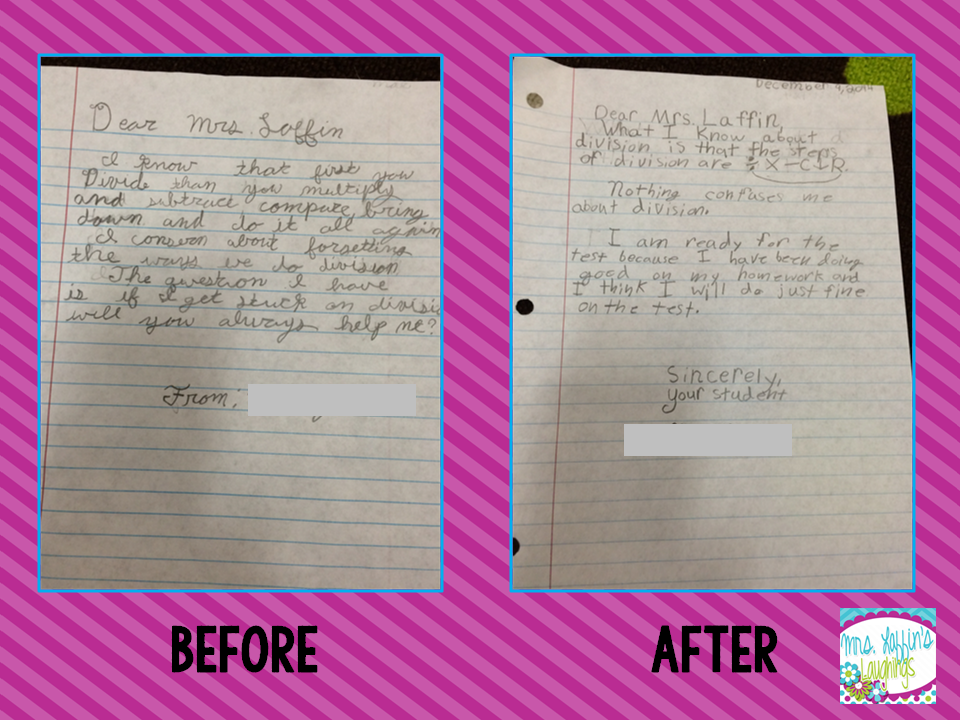
Here are a sample of their letters.  Each picture shows the before and after letters for the same students:
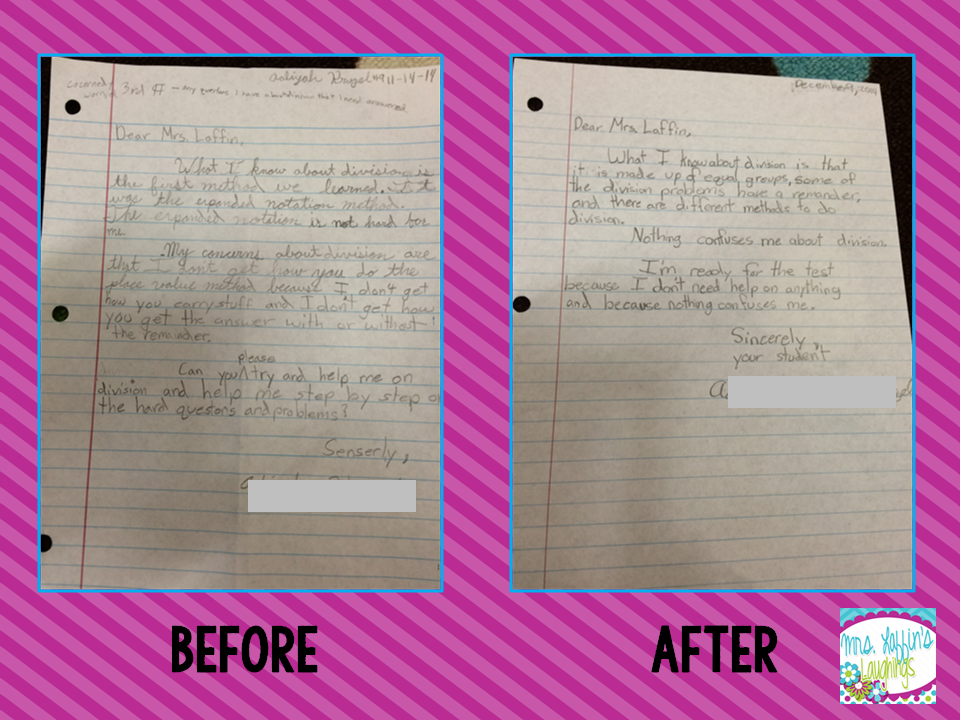

Reading their "after" letters today brought me such joy!  There was a definite change in the tone of the letters.

I shared the before and after letters with the students and we talked about why there was a difference in the letters.  They told me that perseverance, patience, and hard work helped them understand.

One of the best parts of these letters is that now my students have them as a part of their memory.  The next time we do something hard in class (say...fractions), we can recall the before and after letters of division as proof that we WILL make it through, as long as we work hard and understand that even though we may not get it "yet," we WILL.

Sunday, December 7, 2014

Moving for Math

At the beginning of every school year, I always ask my students to share their concerns for the upcoming year.  Without a doubt, many students share that they are worried about fourth grade math.
Logic problems are your foreign language. | 23 Things People Who Can't Do #Math Understand  :D #lol
Perhaps this is because they have struggled with a math concept in the past, they don't have automatic recall of their math facts, or they have an older brother or sister who has scared them about how difficult it is to do long division and add fractions. (That never happens, I'm sure....)

To help change this feeling,  I am trying to put a fun twist on math time that can serve as a good transition activity and brain break as well.

Now, we begin each math class with by Moving for Math!

What is Moving for Math?

It is a short (3ish minutes) of stretching, breathing, and cardio.

We always begin by stretching out:

We stretch our arms, our wrists, our legs...

Then after a good stretch, we hit the cardio to help get some fresh oxygen to our brains and activate more thinking. Usually, this consists of jumping jacks or running in place.  If we do jumping jacks, we count off by multiples of a certain number (to work in a little extra math :).


After a few minutes (once everyone is thoroughly woken up and ready to think), we take a few deep breaths to re-center ourselves.  

Then...we are ready for math.

Moving for Math is fun brain break and a good way to incorporate more movement into our day.  If we are in a rush or I forget about it, the students are quick to complain or remind me.  They have made this short time for exercise a part of our math routine that they rely on.

What I really love is that it starts us out with a positive mindset toward math (especially if we are working on a concept that is new or difficult...long division!)

I find this activity to be a great way to motivate my students for math. I'm linking up with my friend Joanne's Spark Student Motivation linky.  I hope you'll head over to Joanne's blog to find other great ways to motivate your students!

Wednesday, April 24, 2013

Workshop Wednesday -- Card Games Galore!

It's Wednesday which means its time to link up with Ideas by Jivey for her Workshop Wednesday!  This week's topic.....math card games.


By far, my favorite resource for math card games is this book from Scholastic:


One of the things I love the most is that it contains games for upper elementary students for a variety of math topics -- fractions, multiplication, percent, probability, algebra, decimals and more!

Take, for instance, this card game called "Your Average Card" in which students use mental math to find the average of four cards.  To play, each player receives four cards (jokers and face cards removed).  The players find the average of their four cards and round their average to the nearest whole number.  Each player earns that number (the average) of points for that round.  The first player to 50 points wins the game.

Simple, yet fun!  I love games that promote mental math!! :)

I hope you will head on over to Ideas by Jivey for more math card game ideas.  But in the mean time, why not leave me a comment to let me know how you use games in math to promote learning? 

Have a great rest of your week!


Wednesday, April 3, 2013

Workshop Wednesday -- Moby Math!


Thanks to Jivey at Ideas by Jivey for hosting the Workshop Wednesday linky party!  There are some fabulous resources that have already been shared and I've wanted to post about one of my favorite math finds so this is a great opportunity!

I began using the Moby Math website after Winter Break this year and wondered how I lived without it.  It was found by one of our fabulous third grade teachers as she was searching for math intervention resources. 

When students log in to Moby Math (yes, there is a subscription fee, but I think its pretty reasonable and there may even still be a free 30 day trial), they are given a benchmark placement test for all skills beginning in kindergarten.  Imagine my shock to see that some of my students were missing some kindergarten and first grade proficiency skills -- no wonder math was such a difficult time for them!


After taking the placement test, students are given computer guided instruction and practice in the skills that they need to master.  Even students who have mastered all skills up to their grade level continue to grow as they receive exposure to skills for future grades.  You can even assign the program to give students fact fluency practice before beginning their practice sessions -- a great way to keep those math facts sharp! 

While something like Moby Math would never replace quality, best practices instruction, it is helpful in that it is a different way for students to be exposed to math and it is differentiated to each student's needs.

What I also love is that as the teacher, I can have as much or as little control over what my students are working on each day.  I can go into the program and move their practice sessions around, assign extra benchmark tests, or reassign a practice session if the student didn't do so well on it the first time.  For my students who struggle in math, I check their data pretty regularly to make sure the program is truly helping them.  For my students who do well, I may just check on their data weekly.  That way, it is not overwhelming for me and still provides the maximum benefit to the kids!

I have made Moby Math a part of my math workshop so students work on it for about 20 minutes in class, and then I assign 15 minutes to be done at home every night.  The kids love it because they can see their progress and I've also received very positive parent feedback.

Be sure to visit Jivey to find out about other great Workshop Wednesday finds!  Let me know what you think of Moby Math if you check it out!

Wednesday, March 27, 2013

Math Workshop -- The Answer to My Math Prayers

Have you tried math workshop or guided math yet?  I'll have to admit, they have been on my very long "to do" list this year.  I have heard so many fabulous things about it from other bloggers, yet I felt I was not quite ready to try it.  That all changed when I read Guided Math by Laney Sammons last month.


Oh. my. gosh!  Did my life as a teacher of math change.  If you haven't read this book, you must put it on your reading list for spring break.  (Does anyone else read professional development books on school vacations besides me???) 

For those of you already doing guided reading, this will be right up your alley!  Laney breaks down the how and the what of guided math and makes it super easy for you to begin working with small groups during math class.  It fits so perfectly into a math workshop that I am kicking myself for not trying this sooner!

My fourth graders just finished up a unit on decimals using the guided math/math workshop approach and I am so amazed with how well my kiddos did on the end of unit assessment!

I have rearranged my schedule to provide for about 90 minutes of math time.  (This was not easy, but it was important to me so I made it work.)  Students would rotate around four stations (Teacher Time, Independent Work, Math Facts and Math Fun) for about 20 minutes each.  During Teacher Time, I was able to work with my students in a small group setting to give semi-individualized instruction. 

For decimals, I used the math manipulatives (flat = one whole, sticks = 0.10 and blocks = 0.01) to have students model solutions to problems.  It was absolutely amazing!   It was so easy to see when my students "got it" and when they were just pretending.  As a teacher, there is nothing better than when I hear a student say, "Ohhhhhh.....now I get it!" as they are working through math concepts.  And I know that my students LOVED it because they begged me not to go back to the "old way" when we finished our decimals unit.  (Yes, that "old way" is the way I was taught back in the day -- "Sage on the Stage," teacher-centered, student-unengaged instruction.)

There are lots of great math workshop sources out there on the web...I will blog more about them later!

Leave a comment and let me know what you think of math workshop or Guided Math.  If you have any web resources to share, let me know.   I'd love to hear from you!