Showing posts with label Writing Circles. Show all posts

Thursday, February 20, 2014

Word Splash -- Get That Writing Rolling!

I don't know about you, but when I my students begin a new writing project, they want to completely skip the planning stage and go right to drafting.  They write for a few minutes, then stall...thinking they have nothing more to say.

Earlier this year, I thought of a great way to prevent this stalling and to get students to produce a focused burst of ideas for their writing.  I call it the Word Splash.

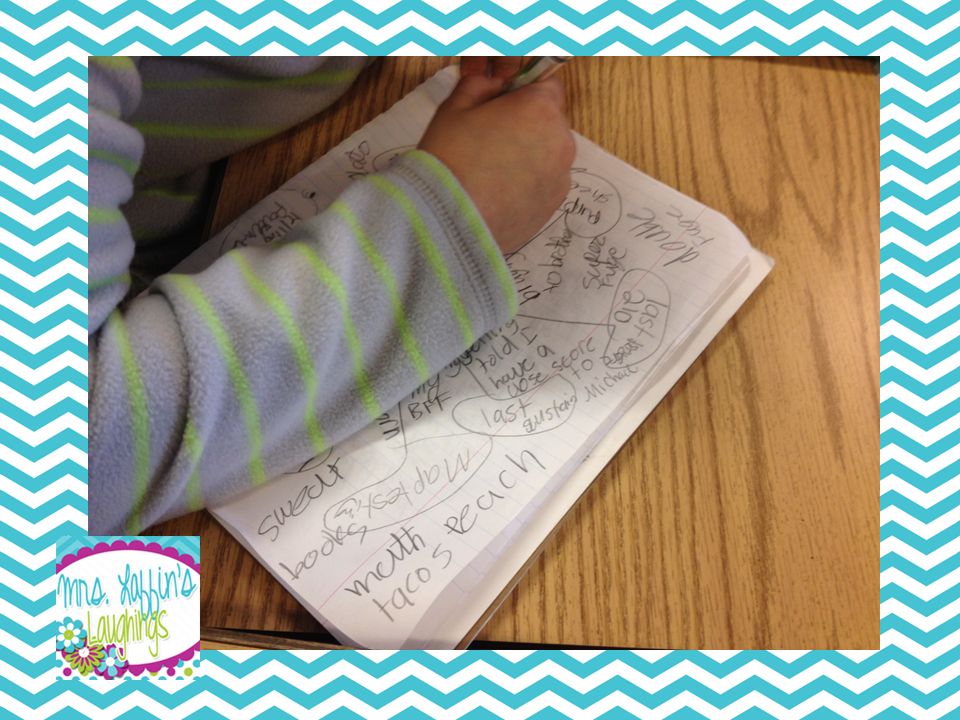
The way it works is students take a page in their notebook (or other paper) and write their topic in the middle of the page.  (It helps to circle it to help it stand out.)  I then set a timer for 3 minutes.  During that time, students write ANYTHING that comes to their mind, even if it has nothing to do with their topic.  (Why?  Because that nonsense is getting in the way of their deeper thoughts coming out.  Once they get it on paper, they can move on with their thinking.)

The only rule is that they have to keep writing for the entire 3 minutes.  They write words or phrases that pop into their head and "splash" them around their page.


Next, comes the fun part...

I set the timer for another three minutes.  During this time, students walk around the room, read each other's topics (circled in the center of their page) and try to add more ideas to each other's Word Splashes.

When we are done, students go back to their own Word Splash, cross out any words that are nonsense or off-topic (those words that were getting stuck in their minds and preventing the good stuff from coming out) and begin to organize the words into categories to develop into a draft.

The result is usually plenty of ideas to get and keep students writing!  They can go back to their Word Splash as a planning tool throughout the drafting process.

What other ideas do you have to get your students to plan out their writing?  I'd love it if you would share some thoughts!

Saturday, February 15, 2014

Why Should You Write With Your Students?

Hello, friends!  Thank you for stopping by today.

I'd like to share something I tried this week that was a super huge motivator for my student writers -- writing WITH them.  I'm also linking up with the super amazing Joanne from Head Over Heels for Teaching.  (Joanne and I bonded immediately over our shared love of the exclamation point!)
I have been doing Writing Circles with my two writing classes for the past four weeks.  What are Writing Cirlces?  Here's a quick tutorial or you can click on my Writing Circles link to the right:
  • Put students into groups of about four writers.
  • Each group chooses a topic to write about.  (This week's topics ranged from "dogs" to "the future" to "memories.")
  • Each student writes a draft on their group's topic.  The genre they write in is the choice of each individual writer.  Drafting takes about two days.
  • Groups come back together to share their drafts and to receive feedback from their group members.
  • Groups choose a new topic and the process repeats.
  • After about four to six drafts, students each choose one of their drafts to revise and publish.

This week, I decided to join one of the Writing Circles in each of my 4th grade writing classes.  (My two group's topics are "the future" and "end of the world."  They could be seen as similar topics that only require one piece of writing from me, but I am writing a separate draft for each topic.)

As my student writers worked on their drafts, I wrote along with them.  They got to see me go through the same processes and struggles that they go through.  It gave value to what they are doing because they knew that if I was doing the writing as well, it was something to be taken seriously.
"The desire to write grows with writing." - Erasmus
Source:  http://media-cache-ak0.pinimg.com/originals/b0/2b/5f/b02b5f227f04399d5185a286e76b36eb.jpg

Then on the second day of drafting, I asked my students if I could have their help.  I was having difficulty with developing the problem for my "end of the world" piece.  I read the piece out loud to the class and asked students to volunteer ideas on what I could do next.  Their ideas were AMAZING and gave me some inspiration for what I want to include in the rest of my story.  My students?  They felt their opinions and ideas were valued because they were helping the teacher.  They felt a part of a real writing community.

Since I've been writing with my students, the quality and amount of writing has definitely increased in my classroom.  It was so quiet one day, we could actually hear the heat come on in the room!  The students are looking forward to Monday where they can share their drafts with their groups and hear the rest of my story.  I'm looking forward to it too because I also feel like we have become a writing community in our tiny classroom.

How about you?  Do you write with your students?  How does your class build it's writing community?

I'm going to check out more motivating ideas at Joanne's blog.  Hope to see you there and also back here tomorrow for my weekly A Peek at My Week linky party.  :)

Have a great day!

Saturday, February 8, 2014

A Peek at My Week {2-09-14}

It's Sunday, and that means it is time for another edition of A Peek at my Week!

What have you got going on this week?
This week, we will begin another round of parent-teacher conferences.  However, in our 4th grade, these are student led conferences.  This is a great time for parents, students and me to sit around a table and hear directly from the student how their year is going, what their goals are for the remainder of the year, and what kinds of help they still need.  We also take time to celebrate the student's accomplishments too -- very important!  Have you ever tried student led conferences?  I would highly recommend them.

As a side note, I saw this on Pinterest and thought it was so funny.  Do you have any students like this???
Source:  http://media-cache-ak0.pinimg.com/originals/a0/08/6a/a0086afbc57c4f9930d0a388ccaa18d8.jpg

Also this week, my 4th grade writers will be revising one of their drafts from their Writing Circles experience to be published.  This was a great experience for all of us and I can see how some of my more reluctant writers have grown through Writing Circles.  (You can read my original post here.)  They have asked for another round with a different response groups so we will begin those on Wednesday.
One of the things that I like the best about Writing Circles is how many of my students are taking the feedback they receive from a draft and are applying it to their next project.  They are trying new things and growing, growing, growing!

This week we are also going to do a little work with fluency.  I had each student pick out a poem they would like to practice.  On Friday, I hope to have a Poetry Cafe, where everyone reads their poem to the class.  Next week, I'm going to be smarter about this.  Instead of ME copying poems out of a book, I'm going to have my students go on Giggle Poetry and print their own.  Have you seen this site?  It is AMAZING!


Have a great week!

Sunday, January 19, 2014

A Peek at My Week {1-19-14}

Here we are, knocking at the door of another week.  We are busy, busy, busy this week, so let's get to it! Thanks for stopping by to check out a Peek at My Week and I hope you will link up and share your week as well.
Writing:
This week, I am going to begin Writing Circles with my 4th graders.  If you are not familiar with Writing Circles, they are a lot like Literature Circles.  I learned about them in the UW-M Writing Project this past summer and are the work of Dr. Jim Vopat.
  
Here is a quick tutorial, but you should really check out the book if you want to do this in your classroom.  It is great!

1.  Group:  Divide your students into groups of about 4-5 students.  Have each group come up with a name for their group (consider it to be something they all have in common, like my group was called "The Procrastinators" :)
2.  Brainstorm:  Each student is given three notecards.  On each notecard, each student writes 1-2 words of a very broad topic (pets, vacation, school, family, memories, sports, etc.). 
3.  Collect & Distribute:  One student collects all of the cards and shuffles them up.  He then deals three random cards to each person in the group.
4.  Discard:  Each student looks at their three cards, chooses one of the three that she would most like to write about and discards the other two.
5.  Rating:  Students then pass their ONE card to the person on their right.  This person looks at the topic and rates it by putting a small symbol in the top of the notecard.  They use these symbols to rate: 
          * = I would be excited to write about this topic
          + = I could write about this topic
          - = I am NOT interested in this topic AT ALL
Continue to pass the cards to the right and rate them until students get their original card back.
6.  Choose a Topic:  Based on the ratings, students choose the topic they will ALL write about.  It will probably be the topic with the most stars (*).
7.  Writing: Students take a designated amount of time to write about their topic.  I plan to give my students the rest of the writing period and one more day to draft.  Students each CHOOSE the genre they will write in, but the topic has to be the same for all group members.  For example, if the topic is "Travel," students could write a poem, a narrative, a vacation review, a newspaper article, an email, etc.
8.  Peer Feedback:  Students then come back together as a group.  They take turns reading their writing out loud to their group.  However, before reading, they tell their group members exactly what kind of feedback they would like.  This is very important as it really helps with the feedback process.  Here are some ideas:
          Connections you had
          Questions that popped in your head as I read my writing
          Does my word choice sound right?
          What did I do well?
          Suggestions for revision
9.  Future Use:  Students can then add this writing to their writer's notebook to use as a writing piece they will take through the entire writing process at a later time if they like it.
10.  Publication:  After about four Writing Circles cycles, ask students to polish and submit one of their four writing pieces for assessment.

I have been excited about Writing Circles since this summer and I finally feel like my students are ready to give them a try.  Can't wait!

Have you used something like Writing Circles in your classroom?  Have any ideas to share?  I'd love to hear them!  :)

Also this week, my baby boy is turning 16!!!!  How did this happen???  While I would like to stop time, I know I can't.  I am so proud of the wonderful young man he has turned into.
Here he is on the day he received his Eagle Scout Award

Monday, July 22, 2013

National Writing Project Day #11: Thought Museums & Writing Circles

 Hi Everyone!

I'm kind of bummed that I don't have anything to share for Monday Made It this week....it hasn't been a very good crafting week for me.  But I've got some new ideas floating around in my head for next week (now all I need is the TIME to get to them!  :)

Today at UW-Milwaukee Writing Project, I learned about two things I had absolutely no idea what they were before today. Kelly, one of our two presenters today, shared her inquiry project on Thought Museums & Writing Circles.

First, Thought Museums

The concept behind this is absolutely GENIUS and it would be so easy to do in your classroom!  The idea with Thought Museums is to get students thinking and writing all at the same time.

Take a poster board and in the middle of the poster board, tape a quote, picture, poem, etc. along with a simple direction such as "What does this poem make you think of?" or "What questions do you have when you look at this picture?".  It is helpful to have about three or four different boards so there is some variety.

Students then walk around with a pencil/pen and write their response on the poster board and sign their name by their comment.  But because this is a museum, it has to be absolutely silent.  After about 5 minutes, students return to their seat and you share thoughts, common observations, themes, etc. from the poster boards. 

Here are some pictures of our Thought Museum today:


As always, I like to reflect on ways this can be used in my classroom (and yours!):
 
  • As a preview activity in science where I post some pictures and main ideas and students respond
  • In math when I post a math question such as "How did you use math today?" and students respond
  • Posting quotations from a book we are reading and students share their connections
  • In character education when students respond to a prompt such as "What does respect look like?"
Really, the possibilities are endless!  I hope you will give Thought Museums a try!
 
Now on to Writing Circles...
 
You may be familiar with Literature Circles in reading class.  Well, Writing Circles are somewhat similar, but unique in their own way.
 
Writing Circles are used in the writing classroom about once a week to promote collaborative, supported writing activity for all students.
 
There several component to Writing Circles, but due to space and time, I will try to highlight what I learned here to give you the idea:
 
1.  Group:  Divide your students into groups of about 4-5 students.  Have each group come up with a name for their group (consider it to be something they all have in common, like my group was called "The Procrastinators" :)
2.  Brainstorm:  Each student is given three notecards.  On each notecard, each student writes 1-2 words of a very broad topic (pets, vacation, school, family, memories, sports, etc.). 
3.  Collect & Distribute:  One student collects all of the cards and shuffles them up.  He then deals three random cards to each person in the group.
4.  Discard:  Each student looks at their three cards, chooses one of the three that she would most like to write about and discards the other two.
5.  Rating:  Students then pass their ONE card to the person on their right.  This person looks at the topic and rates it by putting a small symbol in the top of the notecard.  They use these symbols to rate: 
          * = I would be excited to write about this topic
          + = I could write about this topic
          - = I am NOT interested in this topic AT ALL
Continue to pass the cards to the right and rate them until students get their original card back.
6.  Choose a Topic:  Based on the ratings, students choose the topic they will ALL write about.  It will probably be the topic with the most stars (*).
7.  Writing: Students take a designated amount of time (20 minutes?) to write about their topic.  Students each CHOOSE the genre they will write in, but the topic has to be the same for all group members.  For example, if the topic is "Travel," students could write a poem, a narrative, a vacation review, a newspaper article, an email, etc.
8.  Peer Feedback:  Students then come back together as a group.  They take turns reading their writing out loud to their group.  However, before reading, they tell their group members exactly what kind of feedback they would like.  This is very important as it really helps with the feedback process.  Here are some ideas:
          Connections you had
          Questions that popped in your head as I read my writing
          Does my word choice sound right?
          What did I do well?
          Suggestions for revision
9.  Future Use:  Students can then add this writing to their writer's notebook to use as a writing piece they will take through the entire writing process at a later time if they like it.
 
How do you assess the Writing Circle? 
- Student self reflection and/or group reflections
- Rubric
- Anecdotal record
- Finished product
 
Why use the Writing Circle?
- Promotes collaborative learning
- Teaches students how to seek and provide effective feedback
- Students are offered choice
- Students are in control of this writing time
- It generates new ideas & gets kids writing about topics they may not have chosen for themselves
 

There is an excellent resource available that goes into much more detail called Writing Circles by Jim Vopat.  I am excited to say that my friend, the UPS Man, will be delivering this gem to me very soon!  Can't wait to read it and then I can write more later!!


This is something I definitely want to share with my 4th grade team and the 5th grade because I am so excited about it.  I think it would be awesome if we could all get our students involved in Writing Circles.  (So Jamie, Mickey & Bridget, if you are reading, get ready!  :)
 
Have you ever used Writing Circles in your classroom?  How do you get students to work collaboratively on writing?  I'd love to hear from you!!
 
Until tomorrow!