Showing posts with label collaboration. Show all posts

Wednesday, February 5, 2014

Collaboration & Gray Area Kids

We had our data retreat today.  About two or three times a year, we gather together as a grade level team, along with our principal, the reading and math specialists, our ELL teacher, and the school psychologist to look over the interventions we are offering to students and to discuss how everything is going.

These are long meetings -- about 75 minutes per grade level -- however, the time is well spent when the focus is on student achievement.  I love that so many people are invested in the success of our students and are committed to this collaboration.
LEARNERS by Krissy.Venosdale, via Flickr
This time around, we were also encouraged to think about those students who are in that 'gray area.'  These are the students that are proficient enough in class that they are getting by -- not your high fliers or your red-flagged kids. We all have them in our classes. They don't usually get consistently high grades, may be appear to be unmotivated, sometimes can be behavior challenges, and usually will not ask for help when they need it.

In the younger grades, they were probably your higher students.  The students who "got it" quickly, allowing you time to work with those that didn't.  However, as they moved up in the grade levels and the material got harder and harder and the work became more about reading to learn and not learning to read, the gaps in their learning start to surface and they begin to slip. This usually happens around 4th grade.

So today we took a hard look at those students as well as our red-flagged kiddos.  What can we do to help fill in those holes that they have in their learning to help push them higher?  If we don't catch them now, they may slide with every passing year.

We scheduled some classroom interventions that may give them the push they need.  But I am still unsettled a bit...

We want to think outside the box, come up with something that will reach these kids.  Will it be an intervention?  Maybe.  A different instructional approach?  Possibly.  More one-on-one conferencing?  Perhaps.

We are lucky that we have the power of a team behind us in all of us that gathered today to have this important discussion.  If we keep at it, I'm sure we will find the key.
                                                        Source: http://epherielldesigns.com/20-pretty-free-printables 

How about you?  How do you reach your gray area kids?  How has collaboration helped you?  I'd love to hear your thoughts.

Thursday, July 25, 2013

My Boys are Back! & National Writing Project Days 13 & 14: Collaborative Writing

I'm sooooo excited that my husband and son have returned from the Boy Scout Jamboree!  They got home early this morning around 1:00AM.  Let me just say, they both took a hot shower before going to bed because they haven't had hot water for almost two weeks!

As I blogged last week, my son broke his ankle on his first full day at the Jamboree.  :(  Despite being on crutches, he still had a great time!  The doctors at the Jamboree removed his cast and gave him a temporary cast because his hard cast had gotten too wet from all the rain.  Here is a picture that his scout leader took as they were packing up to come home....that is muddy water his leader is standing in!
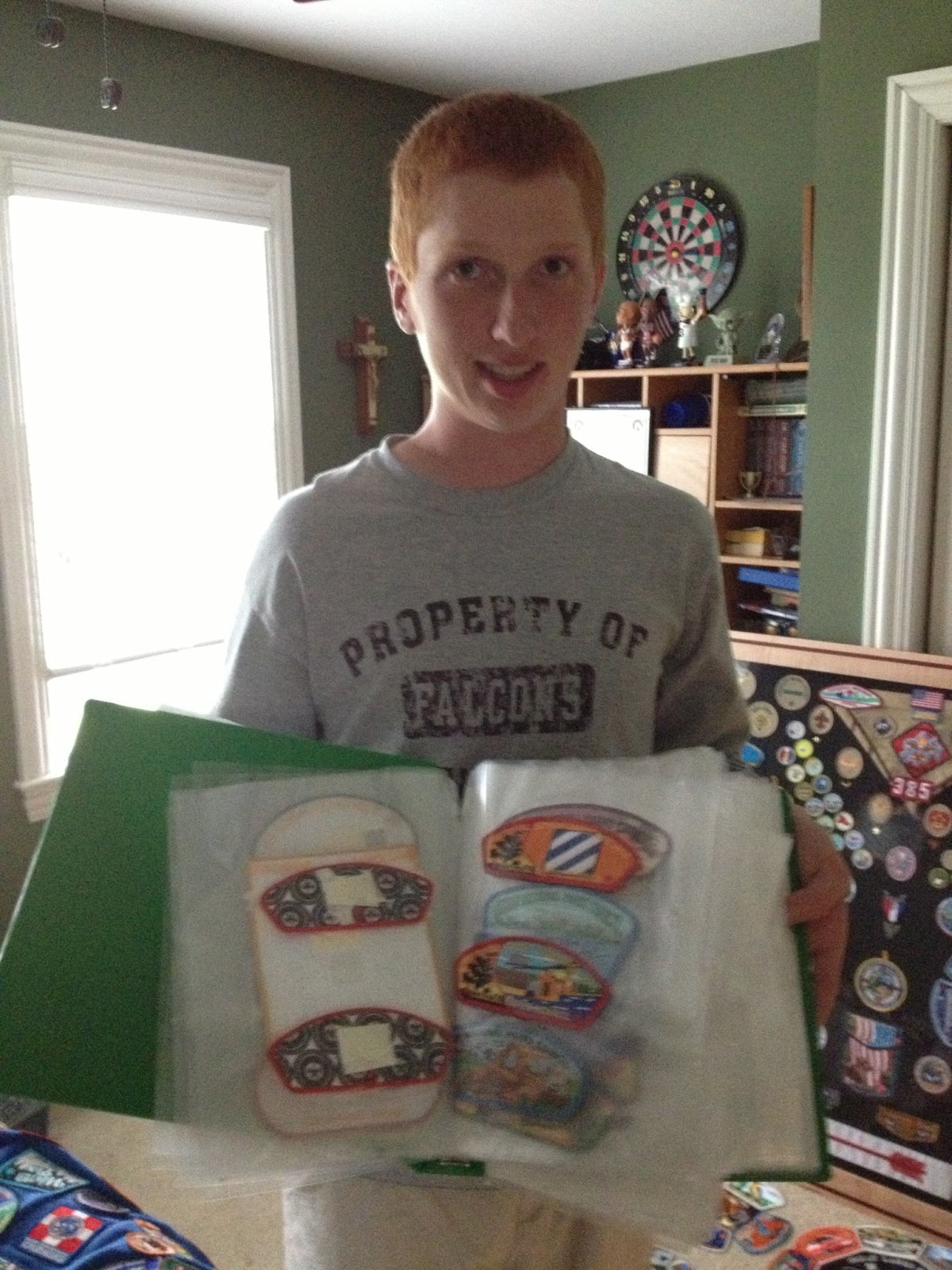
I'm glad to report that a broken ankle didn't stop Ryan from participating in one of the most frenzied activities at Jamboree....patch trading!  This is seriously crazy and I don't understand why.
 
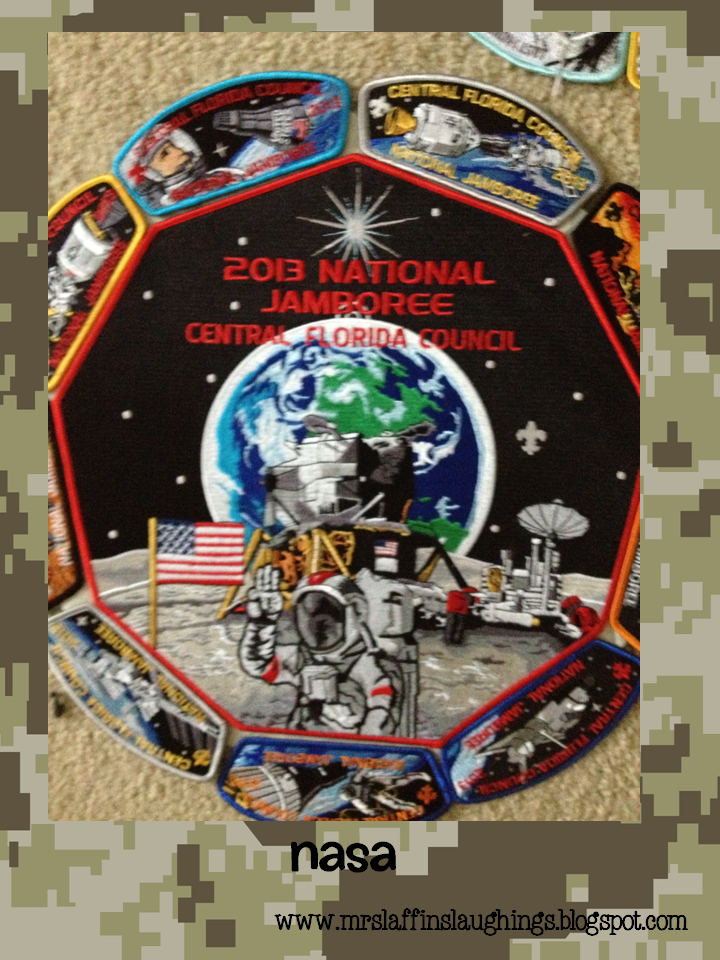
The way it works is that each council designs a patch set to represent their district.  My son's district was from Milwaukee so their patch set was sponsored by Harley-Davidson.  Throughout the Jamboree, the boys walk around and trade their patches for others.  Some of them are very cool!  Here's a look:


Ryan put together a binder of all of his patches...thank goodness I don't have to sew them on!

Now on to the writing portion of this program...  :)

Today at the UWM-WP, Shannon had a wonderful presentation about collaborative writing.  This really got me thinking...Writing is usually a solitary act between the writer and his or her pencil.  But we all know how collaboration can bring about great results and Shannon shared some great activity ideas:

1.  Add a Line:  Give students a stem such as "Johnny knew his trip to the canyon would be risky, but he didn't know.....".  Each student in a group gets a different stem.  They finish the stem and then pass it to their right.  The next person adds to the story, passes, and repeat until the stem has been all the way around the group.  Then the original person can choose to take the collaborative story and revise it or keep adding to it.  It is important that if you do this activity, you carefully model for students how to add a line and that first, they must reread the whole story before adding their line.
 
2.  Content Area Add a Line:  Just like above, but give a stem for something you are studying in a content area such as "The digestive system is one of the most important systems in the human body because...".  This time, students each add a supporting detail to the stem to show what they've learned.  The key here is that there are no repeating details allowed.

3.  Mr. Potato Head:  On a poster board, draw a stick figure (or a Mr. Potato shape).  Each team member is given a different color Post-It pack.  In five minutes, students brainstorm character traits for this stick person and add it to the poster board.  When time is called, the group uses the collaborative character traits to each write their own story.  So the main character will be almost the same for everyone, but the story line will be different. (The different colored Post-Its are to hold each student accountable for adding to the brainstorm and not letting others do all the work.)

4.  Dialogue First:  Partners each write a dialogue on Post-Its for two characters.  They then use the established dialogue to write a story.

Collaborative writing experiences can also occur in a Writing Circle format (see my post about Writing Circles from Monday here) and in the feedback/revising stage of writing.  I think it is a great idea for students to support each other as writers!

Tomorrow is my last day at the UW Milwaukee Writing Project.  I will be so sad to see it end, but I am so excited to take back what I've learned to my classroom, school and district!  Thank you for following me in this journey.  I hope you have learned some new tips for teaching writing!

Monday, July 22, 2013

National Writing Project Day #11: Thought Museums & Writing Circles

 Hi Everyone!

I'm kind of bummed that I don't have anything to share for Monday Made It this week....it hasn't been a very good crafting week for me.  But I've got some new ideas floating around in my head for next week (now all I need is the TIME to get to them!  :)

Today at UW-Milwaukee Writing Project, I learned about two things I had absolutely no idea what they were before today. Kelly, one of our two presenters today, shared her inquiry project on Thought Museums & Writing Circles.

First, Thought Museums

The concept behind this is absolutely GENIUS and it would be so easy to do in your classroom!  The idea with Thought Museums is to get students thinking and writing all at the same time.

Take a poster board and in the middle of the poster board, tape a quote, picture, poem, etc. along with a simple direction such as "What does this poem make you think of?" or "What questions do you have when you look at this picture?".  It is helpful to have about three or four different boards so there is some variety.

Students then walk around with a pencil/pen and write their response on the poster board and sign their name by their comment.  But because this is a museum, it has to be absolutely silent.  After about 5 minutes, students return to their seat and you share thoughts, common observations, themes, etc. from the poster boards. 

Here are some pictures of our Thought Museum today:


As always, I like to reflect on ways this can be used in my classroom (and yours!):
 
  • As a preview activity in science where I post some pictures and main ideas and students respond
  • In math when I post a math question such as "How did you use math today?" and students respond
  • Posting quotations from a book we are reading and students share their connections
  • In character education when students respond to a prompt such as "What does respect look like?"
Really, the possibilities are endless!  I hope you will give Thought Museums a try!
 
Now on to Writing Circles...
 
You may be familiar with Literature Circles in reading class.  Well, Writing Circles are somewhat similar, but unique in their own way.
 
Writing Circles are used in the writing classroom about once a week to promote collaborative, supported writing activity for all students.
 
There several component to Writing Circles, but due to space and time, I will try to highlight what I learned here to give you the idea:
 
1.  Group:  Divide your students into groups of about 4-5 students.  Have each group come up with a name for their group (consider it to be something they all have in common, like my group was called "The Procrastinators" :)
2.  Brainstorm:  Each student is given three notecards.  On each notecard, each student writes 1-2 words of a very broad topic (pets, vacation, school, family, memories, sports, etc.). 
3.  Collect & Distribute:  One student collects all of the cards and shuffles them up.  He then deals three random cards to each person in the group.
4.  Discard:  Each student looks at their three cards, chooses one of the three that she would most like to write about and discards the other two.
5.  Rating:  Students then pass their ONE card to the person on their right.  This person looks at the topic and rates it by putting a small symbol in the top of the notecard.  They use these symbols to rate: 
          * = I would be excited to write about this topic
          + = I could write about this topic
          - = I am NOT interested in this topic AT ALL
Continue to pass the cards to the right and rate them until students get their original card back.
6.  Choose a Topic:  Based on the ratings, students choose the topic they will ALL write about.  It will probably be the topic with the most stars (*).
7.  Writing: Students take a designated amount of time (20 minutes?) to write about their topic.  Students each CHOOSE the genre they will write in, but the topic has to be the same for all group members.  For example, if the topic is "Travel," students could write a poem, a narrative, a vacation review, a newspaper article, an email, etc.
8.  Peer Feedback:  Students then come back together as a group.  They take turns reading their writing out loud to their group.  However, before reading, they tell their group members exactly what kind of feedback they would like.  This is very important as it really helps with the feedback process.  Here are some ideas:
          Connections you had
          Questions that popped in your head as I read my writing
          Does my word choice sound right?
          What did I do well?
          Suggestions for revision
9.  Future Use:  Students can then add this writing to their writer's notebook to use as a writing piece they will take through the entire writing process at a later time if they like it.
 
How do you assess the Writing Circle? 
- Student self reflection and/or group reflections
- Rubric
- Anecdotal record
- Finished product
 
Why use the Writing Circle?
- Promotes collaborative learning
- Teaches students how to seek and provide effective feedback
- Students are offered choice
- Students are in control of this writing time
- It generates new ideas & gets kids writing about topics they may not have chosen for themselves
 

There is an excellent resource available that goes into much more detail called Writing Circles by Jim Vopat.  I am excited to say that my friend, the UPS Man, will be delivering this gem to me very soon!  Can't wait to read it and then I can write more later!!


This is something I definitely want to share with my 4th grade team and the 5th grade because I am so excited about it.  I think it would be awesome if we could all get our students involved in Writing Circles.  (So Jamie, Mickey & Bridget, if you are reading, get ready!  :)
 
Have you ever used Writing Circles in your classroom?  How do you get students to work collaboratively on writing?  I'd love to hear from you!!
 
Until tomorrow!